

View the Created File Automatically
Our Run Commands make it simple to open and view the created file automatically. Viewing the created file helps verify that it contains the expected content before emailing or sharing it with others. It can also be the next step when integrating file creation within a larger workflow.
Quick Links
What are Run Commands
TIFF Image Printer, Raster Image Printer, and PDF Image Printer allow custom actions, or Run Commands, to be run at different stages when you print a file to create an image or PDF file. Use these Run Commands, for example, to open and view the created file immediately after printing.
- Start of Job– At the beginning of the print cycle, when you print the file, but before we start creating it.
- One of the other of the following:
- On Success – When the file creation succeeds.
- On Failure – When the file creation fails.
- On End Job – At the end of the print cycle, whether or not file creation succeeded.
Run commands can have more than one custom command for each stage. Each stage runs its commands in their listed order.
View the Created File
To view the created file, we will add an On Success command that opens the file using the same application as if you had double-clicked the file in Windows Explorer. Viewing what was created can help ensure its correctness.
When opening images, this application is often Windows Photos. Adobe Reader, Microsoft Edge, or Google Chrome are typical applications for opening PDF files. Keep in mind your organization may use different applications. Windows will prompt you to choose an application to view the file if no compatible application is available.
Creating the New Profile
To create a new profile that automatically opens the created file, start by opening the Image Printer Dashboard from the desktop shortcut. The Dashboard offers quick access to all your printer profiles, product licensing, printer management, settings, and help resources.
Select the Edit & Create Profiles tile from the Dashboard to open the Profile Manager. The profile manager is where you edit, copy, create, and delete printer profiles. A printer profile is a collection of settings PEERNET’s image printers use to generate your file. Settings such as output folder, default file name, Run Commands, and others are all saved within each profile.

To create a new profile, you can start with a copy of an existing one or use the Add a profile button to create a new one. Once created, give your new profile a name and a description.

Adding the Run Command to View the Created File
On the Run Commands tab, click the On Success button to add an On Success command.
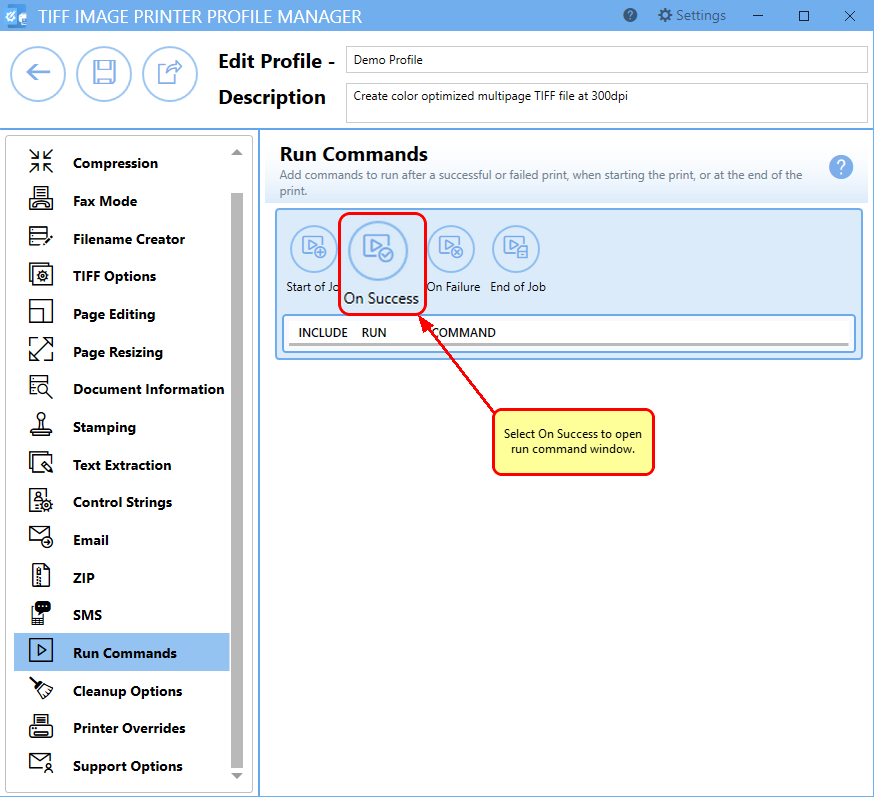
An On Success command appears with its details expanded for you to complete. Each command can be enabled or disabled, allowing you to keep commands in your collection without running them. With this flexibility, you can easily add or remove the command to view the created file as you see fit.
In version 12.0.025 or later of the image printers, Run Commands include additional features not available in earlier versions.
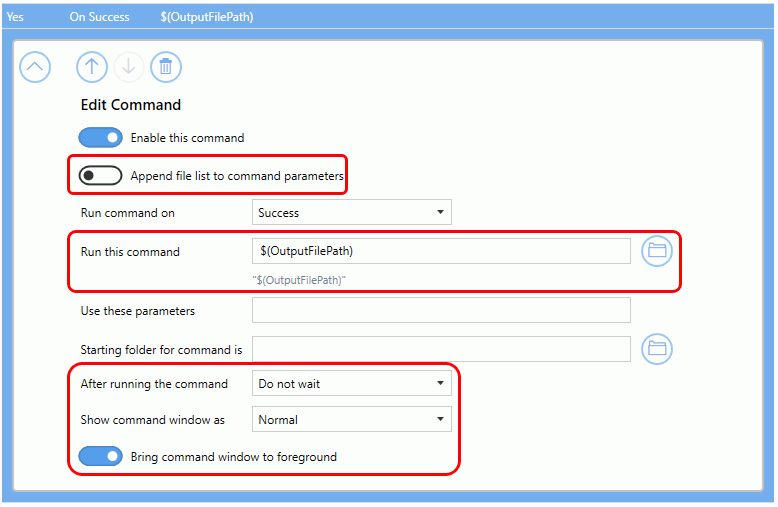
Starting with this version, you can use our built-in macro, $(OutputFileName), for the command to view the created file. Enter this macro into the field next to Run this command and turn off the Append file list to command parameters option.
To display the application that opens the created file, set the following options:
- set the Show command window option to Normal,
- change After running the command to Do not wait,
- ensure that the Bring window to foreground option is selected.
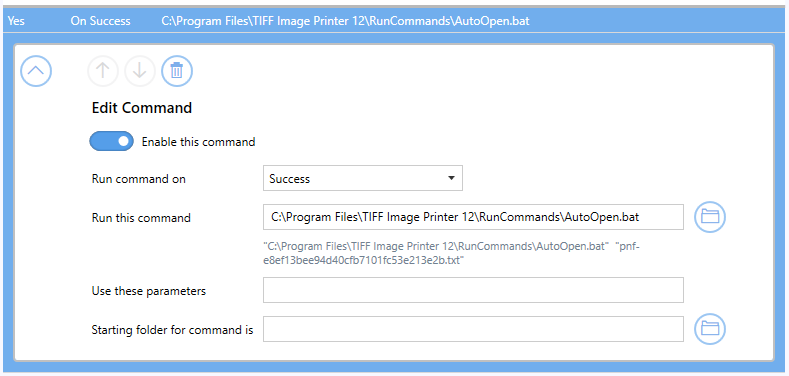
If you have an earlier version, you must use our provided batch file, C:\Program Files\TIFF Image Printer 12\RunCommands\AutoOpen.bat to view the created file. This batch file uses the generated file containing the list of created files to open the file. It will open the created file if the profile generates multi-page output or will display the first page of the output series for serialized output.
Save your changes to the profile by clicking the Save button in the top left corner. Printing using this new profile enables a convenient workflow: your printed output will open automatically, allowing you to view the created file and verify your file before sharing, archiving, or passing it along your workflow process.
Setting Your Profile as the Default Profile
Now that you have your new personal profile, you can use Printer Management in the Dashboard to make this profile the default profile used by your image printer. See Changing the Default Printer Profile to learn more about configuring profiles for your printer and other printer management features.


